1. Vertigo
Alfred Hitchcock, USA 1958
A former detective with a fear of heights is hired to follow a
woman possessed by the past in Alfred Hitchcock’s timeless
thriller about obsession.
The accession of Vertigo to the top spot in this poll is hardly like
a coup d’état. Tying for 11th place in 1972, Hitchcock’s masterpiece
steadily inched up the poll over the next three decades, and by
2002 was the heir apparent to the long-ruling Citizen Kane. Still,
even ardent Wellesians should feel gratified at the modest
revolution – if only for the proof that film canons (and the versions
of history they legitimate) are not completely fossilized.
There may be no larger significance in the bare fact that a couple
of films made in California 17 years apart have traded numerical
rankings on a whimsically impressionistic list. Yet the human urge
to interpret chance phenomena will not be denied, and Vertigo is
a crafty, duplicitous machine for spinning meaning…
— Peter Matthews’ opening to his commemorative poll
essay Vertigo rises: the greatest film of all time?
See all 191 votes for Vertigo

2. Citizen Kane
Orson Welles, USA 1941
Given extraordinary freedom by Hollywood studio, RKO for his
debut film, boy wonder Welles created a modernist masterpiece
that is regularly voted the best film ever made.
Kane and Vertigo don’t top the chart by divine right. But those
two films are just still the best at doing what great cinema ought
to do: extending every day into the visionary.
— Nigel Andrews
In the last decade I’ve watched this first feature many times, and
each time, it reveals new treasures. No single film is the greatest
ever made. But if there were one, for me Kane would now be the
strongest contender, bar none.v
— Geoff Andrew
All celluloid life is present in Citizen Kane; seeing it for the first or
umpteenth time remains a revelation.
— Trevor Johnston

3. Tokyo Story
Ozu Yasujiro, Japan 1953
The final part of Yasujiro Ozu’s loosely connected ‘Noriko’ trilogy is
a devastating story of elderly grandparents brushed aside by their
self-involved family.
Ozu used to liken himself to a “tofu-maker”, about the way his
films – at least the post-war ones – were all variations on a small
number of themes. So why is it Tokyo Story that is acclaimed by
most as his masterpiece? DVD releases have made available such
prewar films as I Was Born, But…, and yet the Ozu vote has not
been split, and Tokyo Story has climbed two places since 2002. It
may simply be that in Tokyo Story this most Japanese tofu-maker
refined his art to the point of perfection, and crafted a truly
universal film about family, time, and loss.
— James Bell

4. La Règle du jeu
Jean Renoir, France 1939
Made on the cusp of WWII, Jean Renoir’s satire of the uppermiddle classes was banned as demoralizing by the French
government for two decades after its release
Only Renoir has managed to express on film the most elevated
notion of naturalism, examining this world from a perspective that
is dark, cruel but objective, before going on to achieve the serenity
of the work of his old age. With him, one has no qualms about
using superlatives: La Règle du jeu is quite simply the greatest
French film by the greatest of French directors.
— Olivier Père
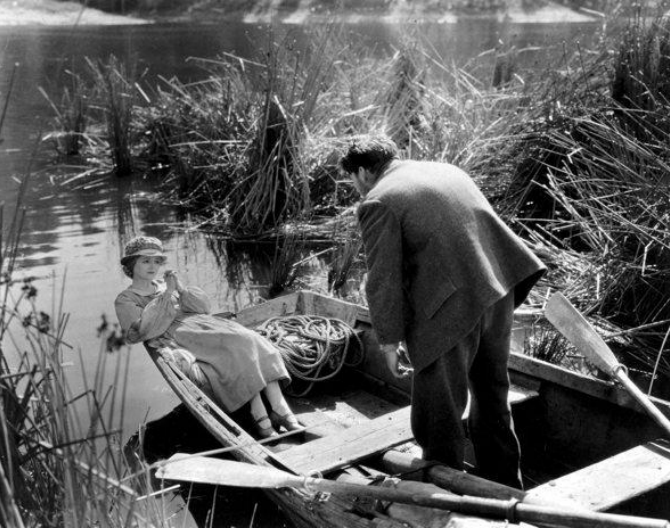
5. Sunrise: A Song of Two Humans
F.W. Murnau, USA 1927
Lured to Hollywood by producer William Fox, German
Expressionist filmmaker F.W. Murnau created one of the silent
cinema’s last and most luminous masterpieces.
When F.W. Murnau left Germany for America in 1926, did cinema
foresee what was coming? Did it sense that change was around
the corner – that now was the time to fill up on fantasy, delirium,
and spectacle before talking actors wrenched the artform closer
to reality? Many things make this film more than just a morality
tale about temptation and lust, a fable about a young husband so
crazy with desire for a city girl that he contemplates drowning his
wife, an elemental but sweet story of a husband and wife
rediscovering their love for each other. Sunrise was an example –
perhaps never again repeated on the same scale – of unfettered
imagination and the clout of the studio system working together
rather than at cross purposes.
— Isabel Stevens

6. 2001: A Space Odyssey
Stanley Kubrick, UK/USA 1968
Stanley Kubrick took science fiction cinema in a grandly intelligent
new direction with this epic story of man’s quest for knowledge.
2001: A Space Odyssey is a stand-along monument, a great
visionary leap, unsurpassed in its vision of man and the universe. It
was a statement that came at a time which now looks something
like the peak of humanity’s technological optimism.
— Roger Ebert

7. The Searchers
John Ford, USA 1956
John Ford created perhaps the greatest of all westerns with this
tale of a Civil War veteran doggedly hunting the Comanche who
have kidnapped his niece.
Do the fluctuations in popularity of John Ford’s intimate revenge
epic – no appearance in either critics’ or directors’ top tens in 2002,
but fifth in the 1992 critics’ poll – reflect the shifts in popularity of
the western? It could be a case of this being a western for people
who don’t much care for them, but I suspect it’s more to do with
John Ford’s stock having risen higher than ever this past decade
and the citing of his influence in the unlikeliest of places in recent
cinema.
— Kieron Corless

8. Man with a Movie Camera
Dziga Vertov, Soviet Union 1929
An impression of city life in the Soviet Union, The Man with a
Movie Camera is the best-known film of experimental
documentary pioneer Dziga Vertov.
Is Dziga Vertov’s cine-city symphony a film whose time has finally
come? Ranked only no. 27 in our last critics’ poll, it now displaces
Eisenstein’s erstwhile perennial Battleship Potemkin as the
Constructivist Soviet silent of choice. Like Eisenstein’s warhorse,
it’s an agit-experiment that sees montage as the means to a
revolutionary consciousness; but rather than proceeding through
fable and illusion, it’s explicitly engaged both with recording the
modern urban every day (which makes it the top documentary in
our poll) and with its representation back to its participantsubjects (thus the top meta-movie).
— Nick Bradshaw
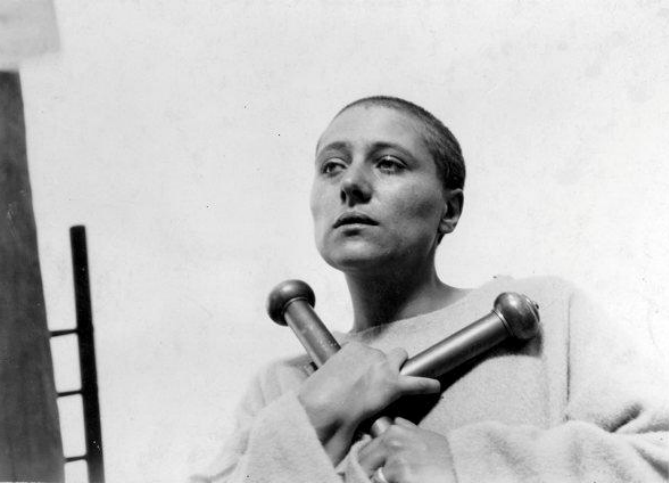
9. The Passion of Joan of Arc
Carl Dreyer, France 1927
Silent cinema at its most sublimely expressive, Carl Theodor
Dreyer’s masterpiece is an austere but hugely affecting
dramatization of the trial of St Joan.
Joan was and remains an unassailable giant of early cinema, a
transcendental film comprising tears, fire, and madness that relies
on extreme close-ups of the human face. Over the years it has
often been a difficult film to see, but even during its lost years
Joan has remained embedded in the critical consciousness,
thanks to the strength of its early reception, the striking stills that
appeared in film books, its presence in Godard’s Vivre sa vie and
recently a series of unforgettable live screenings. In 2010 it was
designated the most influential film of all time in the Toronto
International Film Festival’s ‘Essential 100’ list, where Jonathan
Rosenbaum described it as “the pinnacle of silent cinema – and
perhaps of the cinema itself.”
— Jane Giles

10. 8½
Federico Fellini, Italy 1963
Federico Fellini triumphantly conjured himself out of a bad case of
a creative block with this autobiographical magnum opus about a
film director experiencing a creative block.
Arguably the film that most accurately captures the agonies of
creativity and the circus that surrounds filmmaking, equal parts
narcissistic, self-deprecating, bitter, nostalgic, warm, critical, and
funny. Dreams, nightmares, reality, and memories coexist within
the same time-frame; the viewer sees Guido’s world not as it is,
but more ‘realistically’ as he experiences it, inserting the film in a
lineage that stretches from the Surrealists to David Lynch.
— Mar Diestro-Dópido